In short: Jeet Kune Do is not a fixed martial art with a rulebook, it is a concept. Bruce Lee developed it in 1967, and the name means “the way of the intercepting fist”. You take what works for you and build your own style from it. At our school that means kickboxing, Wing Chun and ground fighting do not compete with each other but form one frame together. Here is Jeet Kune Do explained in practical terms.
What does Jeet Kune Do mean?
Jeet Kune Do was conceived as the opposite of rigid systems. Bruce Lee did not want to leave behind a collection of untouchable rules. One of his sayings is: “Knowledge in the martial arts ultimately means self-knowledge.” The concept works as a mirror: you learn how you move, where your strengths lie and what really works in a given situation.
It follows that there is no fixed method for winning a fight. The aim is flexible, effective self-defence that adapts to the demands of the situation. Anyone starting with Jeet Kune Do therefore gets to know several distances: punching and kicking, close range and the ground.
Which principles apply in the concept?
At its core, the ideas boil down to a few principles:
- Direct and simple: the shortest, clearest movement is usually the best.
- Intercepting: instead of waiting, you disrupt the attack before it takes effect.
- Economy of movement: no step and no movement without a reason.
- Adapting: you change your tools when the situation demands it.
- Learning from every source: what works is useful, whatever style it comes from.
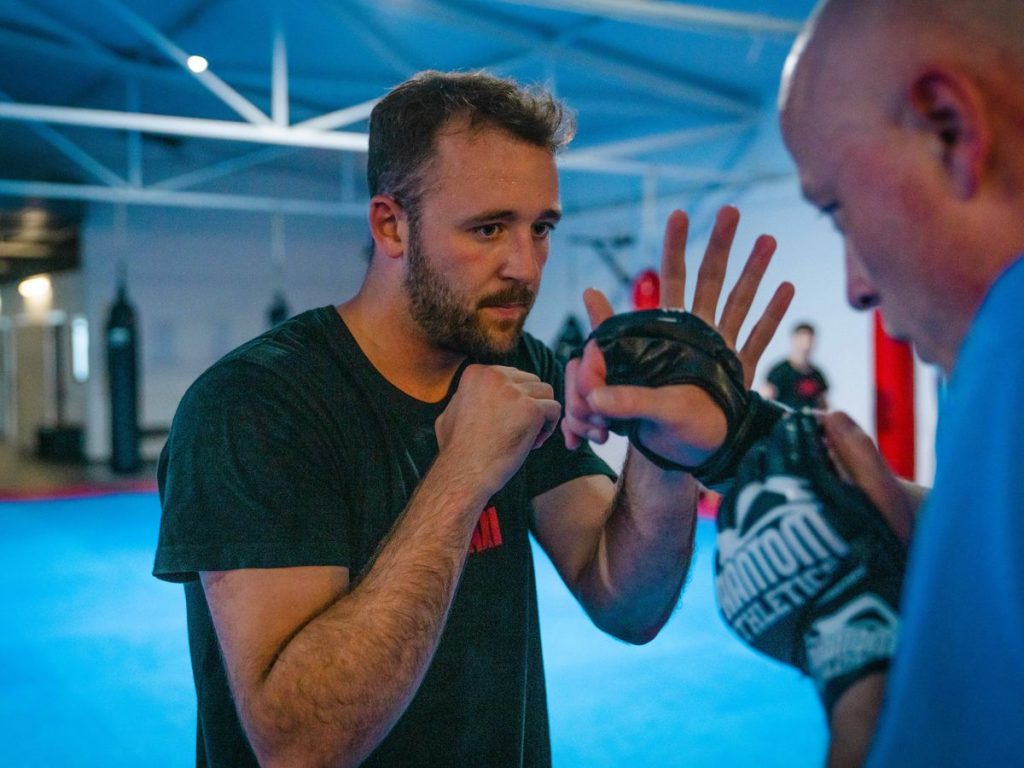
In training you do not meet these principles as theory. They show in partner drills, in the way techniques are combined, and in the fact that at our school kickboxing, Wing Chun, and ground fighting with Brazilian Jiu-Jitsu and grappling all run under one roof.
How does a session run?
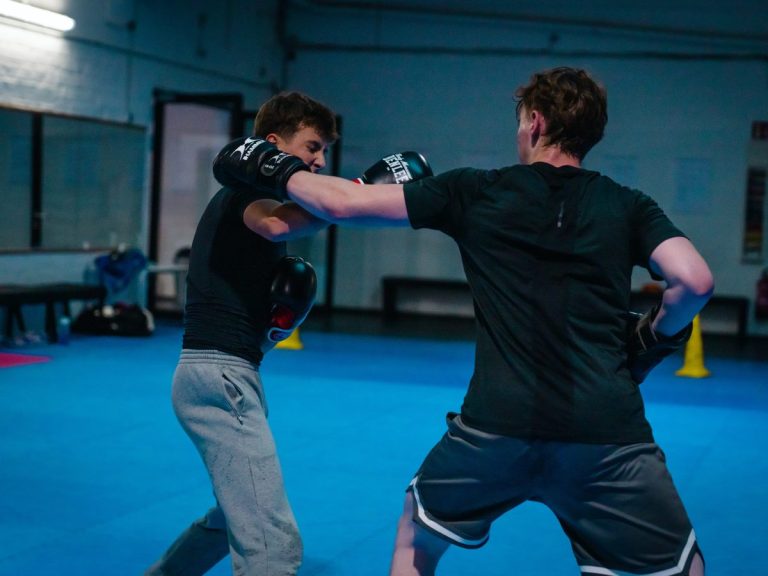
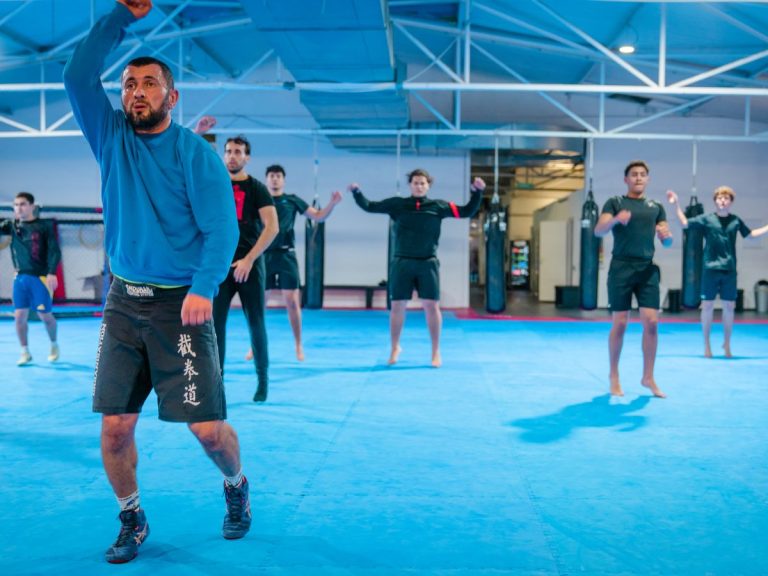
A session follows a fixed pattern: warm-up, technique training with partner drills, sparring and conditioning, and finally stretching and a cool-down. Sparring does not start in the first session. It only comes in once you are ready, technically and mentally.
In the timetable you will find a class called “JKD Kickboxing”. It runs on Tuesdays and Fridays from 19:00 to 20:30 and is open to adults from age 16. Alongside it, several martial arts flow together in our adult classes, for example kickboxing, MMA, boxing, ground fighting, Wing Chun and Kali. Wing Chun, for instance, is the close-range side of the concept; you can read more on the page Wing Chun in Aachen.
Who does the concept suit?
It suits you if you do not want to limit self-defence to one distance or one rulebook. It is also the right place if you like to get to know several areas before you commit. You need no previous experience and no special fitness; the groups start with the basics.
It suits you less if you want to work towards competitions under a fixed rulebook. In that case you are better off in a classic kickboxing or MMA class. If you are still unsure, the article which martial art suits you will help you decide.
Getting to know the concept in Aachen
The school has existed in Aachen since 1995. Its founder, owner and head trainer is Dai Sifu Reza Shouraki, who has trained in wrestling, taekwondo, boxing, Wing Chun and Jeet Kune Do. You can read more about the idea behind it on the page Jeet Kune Do in Aachen.
The best way to find out whether the concept suits you is to try it. You can train twice for free and without obligation, with no contract. We train at Jülicher Straße 216 in Aachen.
Frequently asked questions about the concept
Who invented Jeet Kune Do?
Bruce Lee developed the concept in 1967. The name means “the way of the intercepting fist”. Lee did not see it as a new style but as an approach to drawing out of every martial art what works.
Is Jeet Kune Do a martial art with competitions?
No, it is a concept without a fixed rulebook and not a classic competition sport. If you want to compete under rules, you are better off training in a class such as kickboxing or MMA.
Do I need previous experience?
No. You need no previous experience and no special fitness. The classes start with the basics, and at the beginning you set your own pace.
From what age can I start?
The adult classes are open from age 16. Children train from age 3 in their own groups, and teenagers aged 9 to 15 in youth training based on the Jeet Kune Do concept.
Is Jeet Kune Do the same as Wing Chun?
No. Wing Chun is an independent kung fu style with a fixed curriculum, which Bruce Lee had learned earlier. Jeet Kune Do is the concept that grew out of it and out of other sources.