
In short: A black belt does not mean the same thing everywhere in martial arts. In some martial arts it stands for a completed foundation path, in others it does not exist at all. If you compare martial arts, you should know this before taking a colour as your yardstick.
This text explains where belt systems come from, which sports use them and which deliberately do not, and how you can judge your progress even without a colour.
Where does the belt in martial arts come from?
The coloured belt system is younger than most people think. It arose at the end of the 19th century in Japanese judo and spread from there to karate, taekwondo and other martial arts. The original idea was simple and practical: in a large group it should be visible at a glance who has got how far, so that partner drills can be assigned sensibly.
A split into student grades and master grades is typical. The student grades are examined at comparatively short intervals, the master grades at ever longer ones. In this system the black belt marks the transition, not the end.
Which sports use belts?
- Judo, karate, taekwondo, aikido. Classic belt systems with fixed grading syllabuses, usually tied to a federation.
- Brazilian Jiu-Jitsu. A system of its own with very few colours and additional stripes in between. The intervals are much longer than in karate; a black belt there typically takes many years.
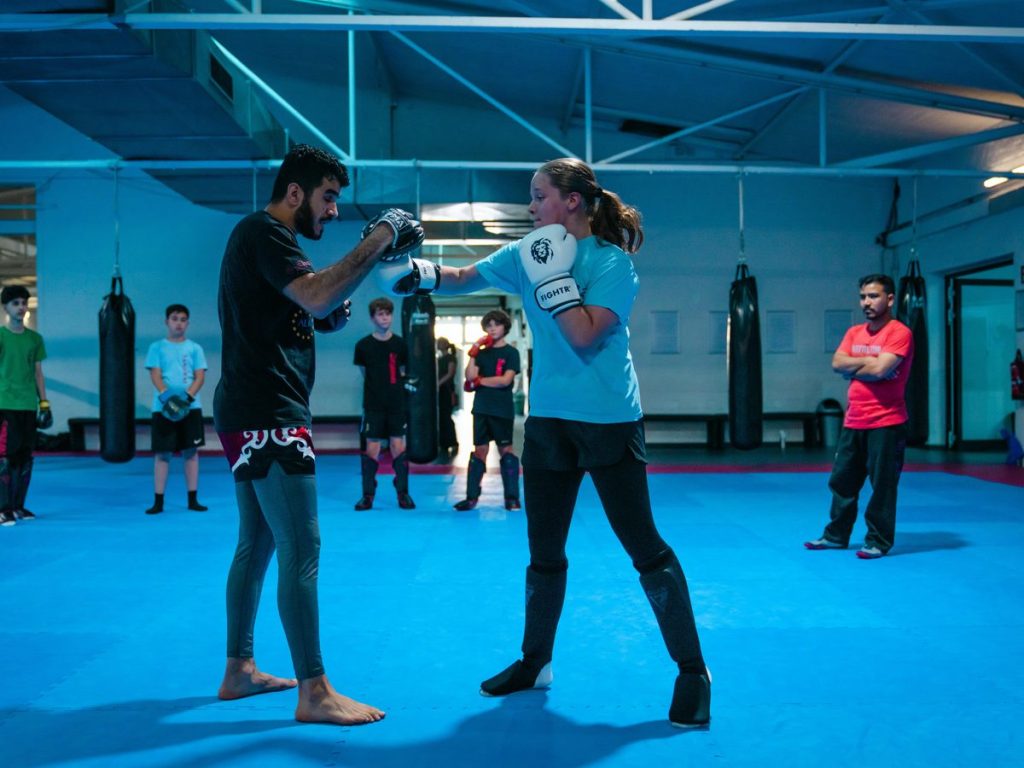
- Boxing, kickboxing, MMA. No belts. Progress is shown through training groups, sparring level and, for those who compete, through competition classes.
- Kali and Escrima. Inconsistent. Some lineages award grades, others work with teaching levels, and still others with neither.
Why do modern martial arts often manage without?
In sports with regular sparring a colour is superfluous because your level becomes visible every week anyway. Anyone who has been doing kickboxing for four months does not need a stripe on the belt to know where they stand: everyday training tells them.
There is a second point. Belt systems only work if the grading syllabus is fixed. Where techniques from different disciplines come together and change over time, such a fixed syllabus is hard to define without freezing the content.
That is why the absence of a belt system is neither a mark of quality nor a shortcoming. It is a decision about how progress is made visible.
What is it like with us in Aachen?
Our training stands under Bruce Lee’s Jeet Kune Do idea: there is no fixed method, but the task of taking what works and adapting. Spread over the week, 27 martial sports and martial arts come together in adult training, including boxing, kickboxing, grappling and Kali.
In Kickboxing there are separate groups for beginners and intermediate as well as for advanced and fighters; in MMA in Aachen the sparring sessions follow the actual performance level. For children and teenagers there are the age groups Panda from 3 to 5 years, Ninja from 6 to 8 years and Samurai from 9 to 15 years; in youth classes they are additionally organised by performance and development levels.
Belts and gradings exist with us in the Panda group (3 to 5 years), the Ninja group (6 to 8 years) and the Samurai group (9 to 15 years). In Wing Chun and in Kali (stick fighting) there are gradings. Gradings take place every 5 to 8 months. In the other adult classes, including kickboxing and MMA, there are no belts and gradings.
How do you actually measure your progress?
The more honest yardsticks are different from a colour anyway:
- Your warm-up. What takes you to your limit in week one is the easy part in week ten.
- Your breathing in sparring. Beginners hold their breath. If you breathe calmly, something fundamental has changed.
- Looking ahead. At some point you no longer look at your partner’s feet or hands but see the movement coming.
- The corrections. They get smaller and finer. That is a better sign than if they stop altogether.
- Your partners. When more experienced people like working with you, that says more about your level than any grading.

What if a belt system matters to you?
That is a legitimate criterion, especially with children: a visible goal every few months motivates many. If that is the deciding point for you, say so openly at the trial class. There is little point in training for half a year and then finding out that the expectation does not fit what we offer.
For everyone else: have a look at how a class is taught, how beginners are treated and whether people are corrected. That decides your progress, not the question of what you tie around your waist.
What a worked-out belt system looks like is shown by the grading system of the German Judo Federation with its kyu and dan grades.
Have a look
Two trial classes are free and non-binding. Use the second session for the questions you have after the first, gradings included. We train at Jülicher Straße 216 in Aachen.
Secure your slot
Book a free trial
Try two sessions for free, with no obligation and no contract. Pick your class and preferred date right here, without leaving the page.
Class schedule
Your week at the dojo
Pick a day or switch the calendar view.
The dates are filtered immediately.
Available classes
Classes on the selected day
No class, no timetable
Try the gym
Just pick a day and drop by during our opening hours. How long you train is up to you.
- Free training on the machines
- No fixed time
- Free and non-binding
Open: Monday - Friday 09:00-12:00, Monday - Friday 16:00-21:00, Saturday 12:00-17:00
How a training evening goes is on the page about the Free trial class. You will find more background texts in the guide section Martial arts knowledge, and if the question of which class is still open, Which martial art is right for me.
Frequently asked questions about belts and gradings
How long does a black belt take?
That depends entirely on the martial art and the federation. In karate several years are usual, in Brazilian Jiu-Jitsu considerably longer. There is no universal figure.
Do kickboxing and MMA have belts?
As a rule, no. These sports work with training groups and, in competition, with classes. Your level shows in sparring.
Do you have belt gradings?
Yes, in some classes: belts and gradings in the Panda, Ninja and Samurai groups, gradings in Wing Chun and Kali. Gradings take place every 5 to 8 months.
Can I bring a belt from another school?
Whether and how previous experience is recognised differs from school to school. Mention your background at the first conversation and it can be settled directly.
My child absolutely wants a belt. What do you advise?
In all three kids’ groups there are belts and gradings, every 5 to 8 months. Feel free to raise it at the trial class.